Showing posts with label Author Interview. Show all posts

01 August, 2017

Author Spotlight: HT Lyon

Greetings, everyone! Apologies for the lack of posting last month, but life got in the way and I wasn't able to get things posted like normal.
 
On the upside, today I'm bringing my last interview with HT Lyon, an author aspiring to write some near-future, hard science fiction based on technology rooted in contemporary science. His work focuses on creating as much realism as possible, so that means no FTL travel, artificial gravity, aliens, etc., but he does this with Economics as his foundation.
 
HT, thanks for joining me. First question: have you written works in collaboration with other writers, and if so: why did you decide to collaborate, and did it affect your sales?
 
HT: I have done a few collaborations for fun and it is incredibly rewarding. The main thing is to build a lot of trust early and spend time working out what each of you is good at!

Here's how they played out. In the first attempt, I was the person writing the first draft and the other person edited and embellished. We worked to our strengths and were happy with the result. The second attempt had me come in and embellish a piece already started by the other author. Finally, the other mechanism that worked well for for myself and my writing partner was to take a character each and write interlocking scenes. This required huge trust that we wouldn't try and force each other's characters into corners or constrain them. It was quick and a lot of fun indeed!
 
Sounds like it! Do you think that giving books away free works, and why?
 
HT: I think it does work and I will do it. Free samples have always been a great way to promote a product or service and books as a form of entertainment are no different. The list revenue is simply another way to fund a marketing exercise. Admittedly it works best in certain circumstances, specifically if you have a series or if it's used to have people signe up for a mailing list. There are millions of customers out there so a few free giveaways is very unlikely to hurt, especially if it does something useful like building a base of fans who have grown to like the author.
 
I think we're in agreement there. Do you have a soundtrack you write to? If so, how does this affect your prose?
 
HT: I don't have a single soundtrack. I do have soundtracks for some of my ideas. I listen to the soundtrack at the gym as I plot the novel and the good thing is that playing the soundtrack helps with recall later. It's like a little like a mental notebook.
 
What do your fans mean to you?
 
HT: I would love to have fans, people who liked my work. I really aren't interested in telling people what to think but I do care that people think for themselves. I would love to think of my fans as people who looked forward to my stories because of the way they made them re-examine their assumptions of the world. Also, if an indie author (or any author) is going to make a serious attempt at writing, then they need a fan base.
Last one, promise. Where is your favorite place to write?
 
HT: Anywhere I can get it done actually, but my most productive place is at home. Unfortunately, depending on what's going on in my life at the time, it can also be the least productive. Lunchtime is another favourite. Crank out an hour of draft over lunch works well. You need to find a quiet spot to sit, though. It really needs alone time.

***
 
HT Lyon is an aspiring writer of science fiction. A futurist with a keen interest in where our society is heading, he tends focus most of his attention on stories that examine the direction our society is taking, or that shows where we could end up. Optimistic by nature, he believes that one day we will look to settle the Solar System as we outgrow our planet, and some of his stories examine how this could look. 

Currently, HT has a number of novels underway and some short stories. His aim is to get one of these up and published before the end of the year around the other commitments that exist in his life.

You can follow him on his website or follow him on Twitter.

11 June, 2017

Author Spotlight: Imogen Keeper

As part of my continuing series of spotlighting fellow authors, this month I'll be interviewing Imogen Keeper.

I had the pleasure of meeting Immy through a critiquing website, and by an exchange, I got to read her Sci-Fi Romance/Erotica novel, The Bonding, before she debuted it. The novel, which is about a princess sent into space in order to save her people, focuses on the unusual bonding between a tribal space warrior and said princess. A bonding rooted in collar-loosening, hand-fanning erotic pleasure. Be sure to check it out if you're looking for a smooth read.

Anyway, let's get started: why do you write?

Immy: Hmmmm . . . I should probably say something really cool and edgy like, "I write because I must," and maybe there's a component of compulsion to it. I certainly feel a writer's high when I finish a great scene, and I feel pride when I'm done editing it and I like it.

https://www.amazon.com/dp/B01MZ5MMS4/
But mostly, I write because it feels more productive to write down my fantasies. Otherwise, I'm just in my head, being lazy and self-indulgent. I'll have the fantasies and dreams no matter what, so I might as well write them down. At least that way, I'm producing something.

You mentioned being proud of your work. What are you most proud of?

Immy: Well, I won't claim that every scene I've ever written is a masterpiece, but there are a couple scenes or characters of whom I am especially proud. I have an Urban Fiction that I'm slaving away at and I have to admit, I love that story. I'm proud of just about every sentence in it, and each character feels like a gift. Like a friend or a child almost. I love those characters intensely.

From my Romance-Eroticas, there is this one scene, it's simple and not deep or anything earth-shattering. It's just about a woman running away from police in a market in a dystopian world, but the details and the wording in it, it just comes alive. It transcends the separation of word and reader and it just sucks you in. Everyone says so when they read it. I just got the balance right. I am proud of that scene. It's from a book that should come out next year, called The Claiming.

Is that what you're working on now?

Immy: Yes and no. I work on a few projects simultaneously to keep myself fresh and my world from getting stale. That is one of the (many) books I'm working on.

Good to know. Can you talk about your process? Specifically, how you go about writing?

Immy: I don't really feel like I'm experienced enough to have a set system. I've finished two books, and have three others halfway finished, and so many more only just begun. I straddle the pants/plot bridge, doing a bit of both. Usually, I get bitten by the writing bug and pound out 10-15 thousand words.

https://www.amazon.com/dp/B06XHD3JH6/
Then I edit that and mull it over, and reread the whole story and make changes. Switch to a new project and work on that for a while. Then come back and do another round of edits, hopefully followed by a major writing session again. Fits and starts. I do force myself to do something writing-related each day. Critiquing, reading, studying, editing, writing, debating with other writers . . . whatever it is, I have to write something every single day.

I see. Last question: what happens if you don't write every day?

Immy: The sky falls down. Kidding. Nothing happens. I go to a party, or take a trip, or have an unavoidable appointment and nothing writing-related gets done. It stresses me out, though. Sometimes more than others. I have a harder time staying in the moment, focusing on real people if I don't get some writing time in.

I'm very shy, naturally. It's a constant battle to come up with something interesting to say in conversation, and I tend to forget to listen to people because I'm so in my head. I find that I'm better able to focus on people when I do get a chance to write. I can relax more, play with my kids with more creativity and energy, talk to my husband and remember to ask the right questions, or go to a party and interact with people in a way that they don't even notice I'm weird, or shy, or awkward, or have these vivid, sexy characters chattering away in my skull.

***

Imogen Keeper has a rampant imagination for all things silly, sexy and sordid. It's hard to keep it all in, so she writes down her daydreams and her night-dreams into the form of big alpha heroes and the ladies who love them.

She was born in DC, lives there now, but did go away for a stint at college where she doubled-down on Art History and Literary Analysis. An MFA, a husband, a house, and two kids later, here she is . . . writing some steamy romance. Her professors in school would laugh.

You can check out her website or follow her on Twitter.

12 April, 2017

Author Spotlight: Tullio Pontecorvo

As part of my continuing series of spotlighting fellow authors, this month I'll be interviewing Tullio Pontecorvo.

Tullio's an author who believes the greatest virtue of speculative fiction is the Socratic exercise. Suppose blank: what are your choices, what are your beliefs? In his view, a good speculative story can tell you more about yourself as a reader than about the author who crafted it, because it doesn't beat you on the head with a stick: it confronts you with a complex situation akin to those we face in every day real life. That's what goes into his writing.

So, let me start with an obvious one. What are you working on?

Tullio: Hello, Ash! Let me just say I'm very happy to be here. My main WIP is a sci-fi novel, sprinkled with alternate history. The setting is the result of WW2 ending on white peace that allowed all major combatants to survive, and led to a fractured, multi-polar international order. Throw in an alien invasion that is not really what it seems, and a wide cast of characters of different ideologies that need to learn how to work together in order to uncover mysteries far bigger than humanity, and you've pretty much got my vision on paper. I'm nearing first draft completion.

That's a lot of detail. Did you have to do much research?

Tullio: Yup, and actually a lot of it is still underway! But no biggie. I love contemporary history and international relations in and of themselves; that they influence my narrative and world building is perhaps an even bigger testament to that.

Drafting and researching? Sounds like you might be a pantser!

Tullio: Indeed! Or a gardener, as GRRM would have it. It's given me plenty of headaches – but also the burning desire to see this story through.

Glad to hear it. So why do you believe stories are so important to us, both as writers and readers?

Tullio: In my view, stories are just models of our reality. Maybe they served some very particular purpose in the darkness of the long nights of prehistory . . . I don't know. But stories are older than writing (just look at the Aboriginal Dreamtime). And they're powerful. We might have gone forward to develop more refined models with philosophy and science, but stories retain the power to convey and explain reality in scale, in bites that we can consume. Of course, the less granular a model is, the more detail you lose, and that's why, at the end of the day, it's fiction.

That sounds cool! And finally, do you have any advice for writers who are starting out their journey?

Tullio: Yes: learn structure, even if you're a pantser. Not a whole lot has changed in this regard since Aristotle, and while structure shouldn't be a straitjacket, or something you necessarily plan against, it should at least help you diagnose your story beats. There's a reason why some structures are prevalent – they are designed to keep the reader interested, and raise the stakes when appropriate.

***

Tullio Pontecorvo is an aspiring science fiction author. He studies political science and international relations, and is currently working on a near-future sci-fi novel that explores the relationship between the individual and the ideological in a complex geopolitical environment. He's also a freelance journalist.

You can follow him on his blog and Facebook page. You can also check out the article he wrote for Earth Island Journal under a different name.

13 March, 2017

Author Spotlight: CL Feindel

As part of my continuing series of spotlighting fellow authors, this month I'll be interviewing Christina "CL" Feindel.

Christina is the author of The Revenant, book one of a sci-fi series about Grayson Delamere, a mechanic living on the fringe of the Trisolar System, who makes her living aboard any ship that will have her. That is, until someone blackmails her into helping recover the ghost ship Revenant and rekindling the fires of rebellion against the all-powerful Federation. If Grayson wants to survive, she'll have to stay ahead of a corrupt government, her elusive blackmailer, and her own dark secrets.

To start us off, Christina, could you please tell us about your preferred tools of choice for writing?

Christina: I can only write on a laptop. My brain just rebels at having to use a desktop, tablet, or anything else. For this project, I started using Scrivener. I’m kind of a hyper-organized person, so I really love the tools a program like that offers. After using it for this, I can’t imagine going back to a typical word processor or, heaven forbid, a notepad like I used when I was in school.

I see, and do you aim for a set amount of words or pages per day?

Christina: I consider it a good day if I get at least 1,500 words on the page or, if I’m working on edits, get through a whole chapter (which is usually about 3,000 words). But most of the time, that doesn’t happen. I write when I can, as much as I can. I’ll get where I’m going eventually.

Interesting. Can you tell us a little about your views on social media marketing, and which platforms have worked best for you?

Christina: I used to work as a social media marketer for a bestselling non-fiction author, and I learned a lot from her. I don't believe you can have a successful campaign without social media anymore. Part of your success in pitching a book or a TV show or any other creative project these days lies in how big your audience already is. I think the thing that works best is just being active and available and honest. You’re building a community, not a sales funnel. People want to connect with you. Encourage that and you might just find successful sales along the way.

I agree! What would you say are the main advantages and disadvantages of self-publishing?

Christina: I don’t have personal experience with both, but I’ve been on the sidelines of traditional publication. It would be nice to have that kind of support from start to finish, and the resources to create a high-quality product that gets widely distributed. But you still wind up doing most of your own marketing, which is probably the part of the process beginning authors need the most help with, so the main advantage of self-publishing is retaining a larger percentage of the profits for all of the hard, often uncomfortable work of advertising yourself.

Okay, final question for today, and this is the hard one. How do you relax?

Christina: I’m kind of a workaholic. I tend to feel a little guilty if I’m not working, writing, or getting some chore off my to-do list. I also feel really good when I’m accomplishing something (even if it’s just cleaning the bathtub). So I have to kind of force myself to slow down and appreciate just being still and enjoying the current moment. Reading is a great way to do that, and I also try to work in some yoga and meditation every day.

***

Christina Feindel resides in central Texas with her multi-talented husband, Noah. While traversing academia, civil service, and chronic illness in early adulthood, she founded the whole-foods blog ACleanPlate.com and now works as a cook, photographer, and educator.

She pens fiction in her spare time, with a particular passion for character development and genre-blending. More info about her and her debut novel, The Revenant, can be found at her author website.

11 February, 2017

Author Spotlight: Zeta Lordes

As part of my continuing series of spotlighting fellow authors, this month I'll be interviewing Zeta Lordes.

Zeta is currently working on a Sci-Fi novella that follows the adventures of a team of Galactic Peacekeepers. The first in a planned series of books, it will follow the efforts of a cadet trying to qualify for field duty, despite the odds being stacked against her. Like many authors before her, Zeta has written a world with endless possibilities, and is planning multiple works within the same fictional universe.

Let's get started now, shall we? Zeta, do you ever model your story characters on real life people?

Zeta: Not consciously, no. Of course all characters are a compilation of real life people, but I don’t think of people in terms of… “gosh they would make a fascinating character to write about”. My characters are strictly the stuff of imaginings.

Do you strive for diversity in your characters?

Zeta: Absolutely. With the caveat that diversity can mean many things both in and out of socioeconomic parameters. Since I mostly write Speculative Fiction, I have a lot of opportunities to write outside stereotype considerations and address diversity from different perspectives. I love messing with how people perceive the lines between differences and likenesses.

What are your favorite types of female characters to write?

Zeta: I almost exclusively write autonomous female characters. Whether they start from a position of strength or weakness, their stories are about their choices and the consequences of those choices. Even when outside forces pummel them beyond endurance (I try to do that a lot), it’s their choice how they live with that. Of course, I often use their own flaws, and even their strengths, against them but ultimately I want to expose the strength and resiliency of character… male or female.

What are your favorite types of male characters to write?

Zeta: I confess I love the Alpha type males to both read and write. No shrinking violets for me. Of course, they have to be true Alphas who deserve and give respect in appropriate proportions and situations. I recently read a book by James Scott Bell called Manliness: The Robert Mitchum Way. It was a fascinating study of the Alpha male. Sometimes a little dated, but never in areas that really count. Like my female characters, I want my male characters to come out at the end a better, wiser [fictional] person than when they started.

Last question! Is there anything you’d like to add about character writing?

Zeta: I think characters are probably the most difficult, and satisfying, aspect of storytelling from both a writing and reading perspective. That includes both protagonists and antagonists. Crawling into a stranger’s head and telling their story in a memorable way, is both liberating and limiting. Obviously it’s more work with primary characters, but I try to make nearly every character shine through in some way. It’s a complex balancing act. Ultimately it’ll be up to the reader how well I do.

***

Zeta Lordes is an author of Science Fiction and Paranormal Fantasy flavored with plenty of suspense and romance.  When she’s not writing, she’s often playing with photo projects, including book covers for herself and other author friends. She lives alone in a rambling house littered with three generations of passed down books and three cats—who have their own litter.


She’s just started reaching out on social media. You can follow her website and Facebook.

27 January, 2017

Author Spotlight: JR Creaden

In continuing with my spotlight of fellow authors, this month I'm interviewing JR Creaden.

JR is an author of Young Adult Science Fiction, and is working to publish RE: MORSE, a novel set in the distant future, which follows the journey of Hugo, a gentle teen who must become fierce to protect four aliens who've won his heart. Re: Morse is a space opera with time travel, a troublesome AI, and a mad teen scientist, and explores issues of friendship, identity, freedom, and consent.

To start us off: would you consider Contact Files to be hard or soft Science Fiction? Are there elements that cross into Fantasy?

JR: Contact Files is soft science fiction, for certain. The plot hinges on the existence and use of a time travel device (a temporal quantum field engine), and there's no such thing. Yet. Alongside time travel, there are site-to-site teleportation devices, and these coincide with matter resequencers. While these are all well-established scifi tech norms, I realize they're pushing the boundaries of true science. For now. I'm a believer in possibility.

The aliens have some quasi-fantastic traits that sit on that narrow fence between hard and soft science fiction. Telepathy, temporal "control", and meta-consciousness are all featured in the first book.

At the same time, the reality created in the book (aside from those mentioned) are drawn directly from hard science. Issues of stellar entropy, genetic diversity, biological evolution, and cosmic life cycles are at the root of the problems the characters must solve.

What do you find is the hardest thing about writing?

JR: All parts of writing come with their own challenges from my experience. In the planning stage, there's the struggle for looking for that balance between a unique hook and a familiar or believable setting. During the writing, there's the challenge of getting lost in tangent, of finding the best scenes and the best way to frame them. Once I'm editing, the hardest part is listening to critique and making the hard choices to cut or expand, rewrite or erase.

I find I push boundaries with each writing stage, honestly, so perhaps these things would be easier if I stopped trying to fight every battle at once?

Have you written works in collaboration with other writers, and if so: why did you decide to collaborate, and did it affect your sales?

JR: I'm currently ghostwriting a story for an engineer, but that project is still in development, so I don't have any sales projections. I decided to work with him, because I found his ideas surprising and strange. It seemed a shame that, since he "doesn’t write", his story would never be told without help. I'm a helper.

When I started Contact Files, I knew right away that this was an enormous task for one writer. Can I do it? Of course I can, but it may take me a decade to pour everything out. I'd love to find other writers to work with on the later books or adapting the books to screenplay.

Knowing what you do now, what advice would you give to your younger self?

JR: Don't marry a narcissist; it's detrimental to your health and purpose. Be wary of toxic people of all kinds, because you will attract them like flies as you stomp unawares through life. Stay light-hearted and open-minded, that's who you are, but don't be afraid to say "no" or to stand up for yourself.

Back up every draft, so you don't end up rewriting the same chapter five times. Seriously, losing work is extremely frustrating.

Last one: if you could only read one book for the rest of your life, which would it be?

JR: Tom Robbins' Still Life With Woodpecker. If you only get one book, it might as well be a book prepared to sell you on the value of a "single" thing.

***

JR began her writing career as a child disgruntled with song lyrics. After some early success with poetry and essays, she spent decades distracted by songwriting and academia until her story dreams became too interesting to keep to herself. Her current YA space opera series Contact Files will soon be ready for public consumption or vivisection.


Her goal is to share stories that inspire readers to embrace cultural diversity, the promise of science, and the value of humor and imagination to build a future that's more Star Trek and less 1984. When she's not writing, JR enjoys exchanging "your mama" jokes with her children, floating in lakes, and slaying virtual dragons. You can follow her on her Website, Twitter, and Facebook.

13 December, 2016

Author Spotlight: Alasdair Shaw


In continuing with my spotlight of fellow authors, this month I'm interviewing Alasdair Shaw.
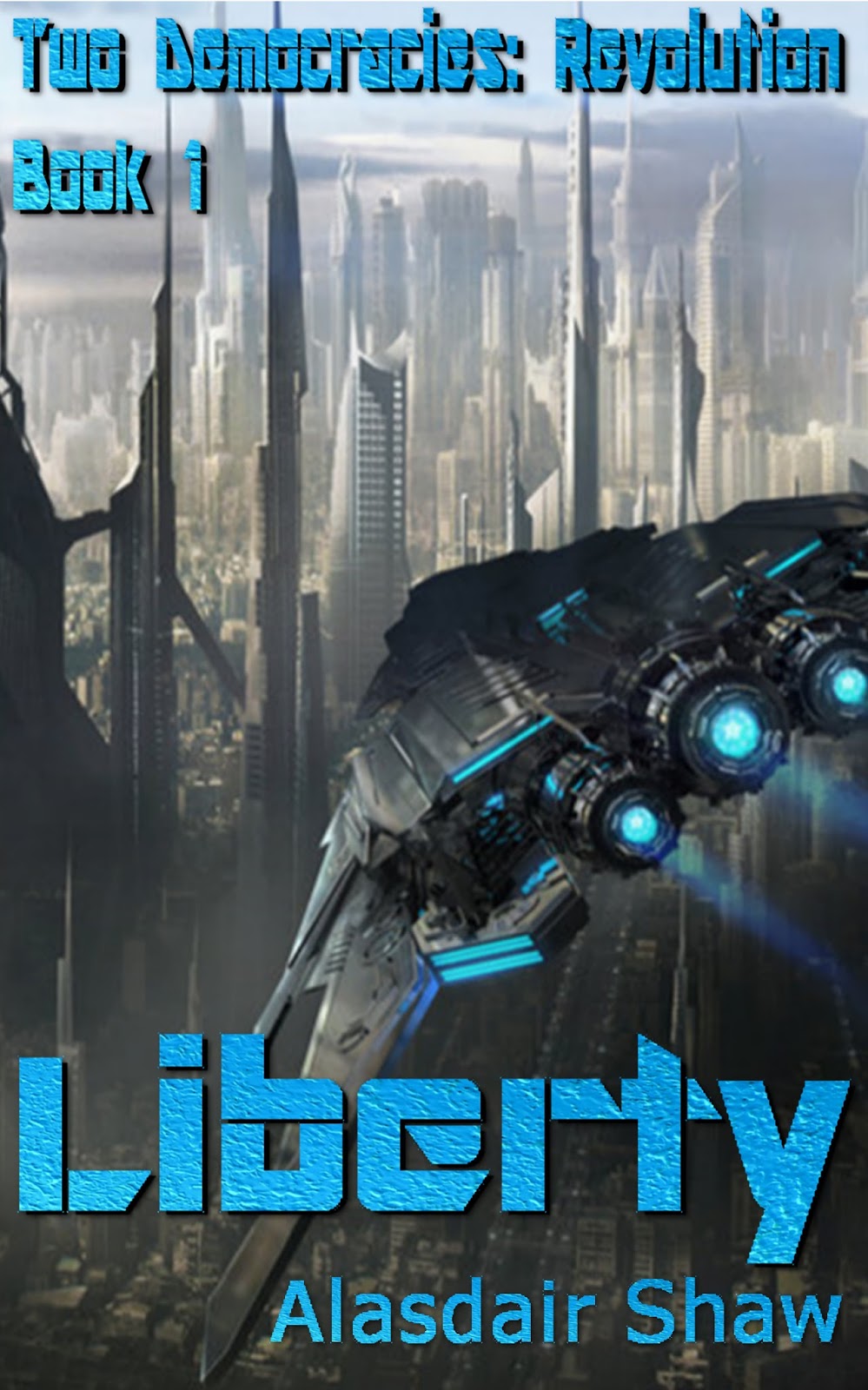
Alasdair is the author of The Two Democracies: Revolution science fiction series, which starts with Independence, and continues with Liberty. The third story, Equality, will hopefully be released in summer 2017, followed by Fraternity the year after.
Give us an insight into your main character. What does he/she do that is so special?

Alasdair: The Two Democracies: Revolution series has two equal main characters.
One is Indie, the primary AI personality of the ship The Indescribable Joy of Destruction. He is the first known sentient AI, something of a taboo in the existing society. He was accidentally liberated by the other main character, Commander Olivia Johnson. She is an inspiring officer, despite having battled depression since she was a young girl. Even though they come from opposing sides in a generations-long civil war, they become close friends, helping each other overcome their inner daemons.
If you could place Indie in any other fictional world, which would he most enjoy?
Alasdair: Most certainly the Culture. The respect given to the Minds, and the rights afforded to all artificial intelligences, would make him very happy. I see him working towards establishing just such a society in the future.
What drew you to write in this genre?
Alasdair: I have always enjoyed reading science fiction, especially space opera and military SF. As a physicist, I find describing the technology entertaining. As an Army Reserve officer, I am intrigued by the possibilities of future combat.

Do you have any advice for other authors on how to market their books?
Alasdair: By and large, you get what you pay for. Returns tend to scale disproportionately, so a small increase in cost frequently relates to a large increase in effectiveness. There are some effective free or $5 promos, but they are few and far between.
Make good use of your KDP countdown deals. If you are writing a series, there is an added bonus of sell-through to your paid books when you put your first one on free.
Even if trad publishing, you should market your book. One author I heard recommended spending your whole first advance on advertising. Your publisher is more likely to throw their A-game advertising at it if they see it selling well.
 
Finally, take part in multi-author cross promo opportunities. These can range from discounted book listings (like Patty Jansen’s Science Fiction and Fantasy Promotions) to anthologies and boxed sets (like The Newcomer collection of science fiction short stories that I just edited).
What is your guilty pleasure?
Alasdair: Butter. I never really had much of an affection for it until I became lactose intolerant. Now, lactose-free butter is heaven. Lashings of it on granary baguette, or on whole-grain crackers – divine.

***

Alasdair Shaw grew up in Lancashire, within easy reach of the Yorkshire Dales, Pennines, Lake District and Snowdonia. After stints living in Cambridge, North Wales, and the Cotswolds, he has lived in Somerset since 2002.
 
He has been rock climbing, mountaineering, caving, kayaking and skiing as long as he can remember. Growing up, he spent most of his spare time in the hills. Recently he has been practicing his skills ready for the winter climbing season.
 
Alasdair studied at the University of Cambridge, leaving in 2000 with an MA in Natural Sciences and an MSci in Experimental and Theoretical Physics. He went on to earn a PGCE, specialising in Science and Physics, from the University of Bangor.
You can sign up to Alasdair Shaw’s mailing list at https://app.mailerlite.com/webforms/landing/k9x9t2  and see what else he gets up to on his website.
The Two Democracies universe intersects with our own at Twitter and Facebook.

28 November, 2016

Author Spotlight: Heather Hayden

In continuing with my spotlight of fellow authors, this month I'm interviewing Heather Hayden.

Heather writes Sci-Fi and Fantasy for the Young Adult age group. She loves action, and has a penchant for the unexpected. In recent months, she's been working on Of Beauty Within, which is a novelized, gender-swapped retelling of Beauty and the Beast. Her debut novel, Augment, was independently published, and mixes elements of both science and science fiction, while exploring themes of friendship and what it means to be human.

Let's open with something simple. When did you decide to become a writer?

Heather: I’ve been dabbling in writing for as long as I can remember. I finished my first novel in 2007, thanks to the challenge of National Novel Writing Month, and after that, I just kept writing. I did NaNoWriMo every year, JanNoWriMo for as long as the forums existed, and other writing challenges. I’ve won prizes in local contests for flash fiction and poetry, as well. I think I always planned on writing as a hobby, but after a few years at college, trying this, that, and the other thing, I realized that writing was really what I wanted to do. That’s when I decided to pursue it as a career.

I see. Are you currently writing full-time or part-time?

Heather: A bit of both, really. My current job is online and part-time, so I try to write whenever I’m not working. Eventually I’d like writing to be my full-time job.

That's a wonderful aspiration. Do you have a favourite motivational phrase to keep yourself on track?

Heather: I have several phrases I love, but I think in terms of motivation, CJ Cherryh takes the cake. She said: “It is perfectly okay to write garbage - as long as you edit brilliantly.” This strikes a deep chord in me, because as a pantser, my first drafts are often in need of help . . . which they get during the editing process.

I know you've published one novel already. What made you choose to pursue independent publishing?

Heather: I wanted more control, so publishing independently made the most sense. Plus, with hard work and a bit of elbow grease, it’s a lot faster to self-publish books than to seek representation. I plan on releasing two-to-four books a year, and having the control over prices, book covers, etc., is important to me.

Very insightful. Okay, last thing: it’s November! Are you participating again in National Novel Writing Month this year, and, if so, what's been your experience with it?

Heather: Yes! NaNoWriMo is actually what first got me writing novels. I started participating in 2007 after reading a magazine article about the challenge and finished with a 60,000 word novel about a mute girl and cats who lived in shadows. After that, I kept writing and didn’t look back. I’ve been participating every year since then. Some years were more difficult than others—during high school, I had a lot more free time (yay for homeschooling!), while during college I had to make time for my writing among everything else. Thankfully, my college had a trimester system and the first trimester ended mid-November—often my novel would get written during the last two weeks!

***

Though a part-time editor by day, Heather Hayden's not-so-secret identity is that of a writer—at night she pours heart and soul into science fiction and fantasy novels. In March 2015 she published her first novella, Augment, a YA science fiction story filled with excitement, danger, and the strength of friendship. She immediately began work on its sequel, Upgrade, which continues the adventures of Viki, a girl who loves to run, and her friend Halle, an AI. You can learn more about Heather and her stories through her blog and her Twitter, both of which consist of equal amounts of writerly things and random stuff she’s interested in.

14 October, 2016

Author Spotlight: Tabitha Chirrick

Welcome to the next installment of my author spotlight. This month, I'm interviewing Tabitha Chirrick, who is a self-published Sci-Fi writer, who recently published her first novel, Overshadowed.

Tabitha, what drew you to write science fiction?

Tabitha: There are two kinds of science fiction: philosophical “this-could-be-the-future” sci-fi, and pulpy “there-are-booms-and-lasers” sci-fi. I’m the shmuck who writes about booms and lasers.

I like Clarke, I like Herbert, I can tolerate me some Asimov, but I’ve always been drawn to what I wish was commonly called science fantasy, by which I mean fantastical stories in future or hi-tech settings rather than places with trees and tiny villages. Think Star Wars or Fortune’s Pawn or Ender’s Game. I find the marriage between the fantastical and the science fascinating, and have always been drawn to stories that fall into this genre. It’s a joy to write in, and feels truly limitless.

Fascinating; "Sci-Fa" should definitely get more attention as a separate genre! What did you think was the hardest thing about writing Overshadowed?

Tabitha: That’s a tough one. I ran into all sorts of challenges: cutting major characters and rewriting over the gaps, balancing multiple point of views, keeping the dark side likeable, and the ending, of course. Had to carefully consider the number of explosions.

But I think, even everything else considered, the hardest part was the beginning. I rewrote the intro almost twenty times – full rewrites, not tweaks or basic edits. I got a lot of feedback over the entire writing process, and every beginning I wrote seemed to have a major pacing flaw. Starting too soon, starting too late, starting too slow, starting too fast, and on and on and on the problems went.

Luckily, I had a lot of patient critique partners, and ended up with a beginning better than all prior versions. Looking back, there are still things I would change (aren’t there always?), but I’m happy with how it turned out. Beginnings are tough. They have to accomplish so much!

How often do you write, and do you have a special time during the day to write?

Tabitha: My writing schedule is all over the place. Whole chapters written in between rounds of Halo, 3AM insomnia notes, paragraphs of plot while I’m waiting for dinner to finish, and, occasionally, a very normal couple thousand words in a writing-only afternoon. I’m trying to make the latter my typical day. I mean, I get the work done, but maybe not in that stereotypical "sitting in a big chair sipping tea while the words pour out for hours" kind of way. I wish that was my process. Tea is good, and I like big chairs.

What is your favorite motivational phrase?

Tabitha: “Just do it.” – Nike . . . or is it Shia Labeouf now? Eh, either way.

LOL! Okay, last question. What advice would you give to aspiring writers?

Tabitha: . . . Just do it.

Okay, but really, I’d tell them to read broadly, practice deliberately, converse with their writing peers, and, yes, actually do the writing part. Talking about writing isn’t writing. Tweeting about writing isn’t writing. Sharing writer jokes on tumblr isn’t writing. Writing is writing. Do all that other stuff too – those things are fun – but make sure you actually write. Growth happens in the act.

***

Tabitha Chirrick is a writer of all things speculative, geeky, and/or badass. Overshadowed - a YA Sci-fi - is her most recent release, though you may have also seen her work in Pigeonholes, Unbroken Journal, or even the International Conference on Interactive Digital Storytelling. She has a BA in Creative Writing from the University of California Santa Cruz, lives in Silicon Valley, and aside from reading and writing, her favorite pastimes include cooking, gaming, stargazing, and tempting deadlines via the power of procrastination! You can follow her on her website or Twitter.

29 September, 2016

Author Spotlight: Jim Moran

Welcome to the second installment of my author spotlight series. This month, I'm interviewing Jim Moran, a Sci-Fi writer who's currently working on an epic space opera.

When did you decide to become a writer?

Jim: Heh. I don’t think I’ve really “decided” that. Or, maybe I’ve always been a writer. I don’t know. I write a lot, but not professionally as of yet. Have I decided to pursue a professional career as an author? Maybe that’s the better question, but if it is, then I don’t have a good answer for it yet.

Life is a grand adventure, right? I’m still just making things up as I go, for the most part. Ask me again in a year.

What do you think is the hardest thing about writing?

Jim: For me, it’s everything not directly related to the writing.

I think I’ve found a workable approach to writing. I don’t have much of a problem coming up with ideas, building a workable framework around those ideas, writing, revising . . . all that stuff, I’m fairly comfortable with my efforts and abilities.

But once I have a finished product, ask me what I’m going to do with it, and holy smokes I have no idea. A couple of years ago, this wasn’t even a thing that had anything to do with me. Now people are asking me stuff like “Are you going to get an agent?” and “What do you think about self-publishing” and “What do you think about the Hugo Awards?” and “What’s your query look like?” and I have no idea.

Okay, I have a few ideas. But “a few ideas” is about as far as I’ve gotten. My whole writing endeavor started on a whim, and things have basically been stumbling along towards progress ever since.

I feel like I’ve just baked a birthday cake for a three-year old’s birthday party, in a calm and peaceful kitchen, and I’m quietly pleased (and a little surprised) by the results. Meanwhile, there’s this muffled background murmur that has been present the whole time, but it’s in the distance. It doesn’t affect me right now. Right now, it’s just me and this cake I made.

But the cake isn’t for me, it’s for everybody. So I open the kitchen door and AAAAAAAAAH! AAAAAAAAAAAAAAH! AAAAAAAAAAAAAAAAAAH! Now I’m being mobbed by a bunch of wildlings. Some of them want the cake, others think the cake looks gross and immediately want me to bake a different cake, and both groups are shouting. Some of them just want different icing on the cake, as if that’s a reasonable request. Some are grabbing for the cake without asking. One of them punched one of the other ones, and they’re both crying. Somebody isn’t wearing pants. Somebody else is trying to hang on my leg with every step I take. Everybody’s running around and screaming and carrying on and it’s chaos. Chaos.

Part of me wants to just hurl the cake into the room and retreat to the kitchen, where it’s quiet and sane. Part of me wants the kids to eat the cake, because I think it’s a pretty good cake, damn it, I worked hard on it, and I want those that might enjoy it to at least try a slice. Part of me wants to stop belaboring this metaphor and move on to the next question.

But yeah. The writing, I don’t have a problem with it. Everything else, on the other hand . . .

Did you come across any specific challenges in writing Focus?  What would you do differently the next time?

Jim: I would spend more time, earlier, thinking about how I wanted my characters to progress. When I first started knocking words together, most of my major characters had a bit of personality but no growth. Some of that growth I backfilled, some of it I shoehorned in later, but I didn’t really get a good handle on where I wanted these characters to be until I was about two-thirds of the way through. Then I had to go back and rewrite a bunch of stuff. It was a decent amount of work that could have been avoided had I been thinking about it from the start.

Also, I wish I’d created my little wiki program sooner. It’s been a big help for remembering little details.

With respect to your writing career thus far, would you have done anything differently?

Jim: It’s not really a “career” thing for me, at least not at this time. And I really have no significant regrets as to where I am now. But if I were to change something, it would be to get started earlier. Like, at least a decade earlier.

My writing wouldn’t have started out nearly as well (relative to where it is now, anyway) but I’d understand the industry a lot more and I’d be more comfortable and experienced dealing with a lot of the extracurriculars.  Who knows where I’d be today?  Still a programmer, probably, because my day job is a fulfilling endeavor that I enjoy. But, writing-wise, I’d certainly be better prepared for whatever the next step should be.

So . . . yeah. Get started early.

Final question: which famous person, living or dead would you like to meet and why?

Jim: Any number of folks, really. Right off the top of my head, the first name I can think of is Theodore Roosevelt.  I would buy that man a drink. He’s gotta have all kinds of interesting stories to tell.

***


Jim is a random guy on the Internet who accidentally fell into this whole "writing" thing. He is terribly inexperienced in virtually every aspect of the writing endeavor, and is currently just making things up as he goes. What fun! He has a blog.

______________________________________________________________________

Ash Litton

Ash Litton is a writer and lover of sci-fi, fantasy, and all things fictional. She is the author of Thoroughbred, Evening Hallow, Comeuppance, and Cabover Cabaret, and works on other Appalachian Dream Tales between her ongoing novel projects. She's also written No Diet, No Surgery, No Sweat, an ebook chronicling her weight-loss journey.

When she's not writing, she's drawing, and when she's not doing either of those, she's dreaming up new projects to work on. Born and raised in rural West Virginia, Ash has always wondered what things lay hidden in the hills around her. She attended West Virginia University, where she studied the English language before returning home to her family in rural West Virginia.